


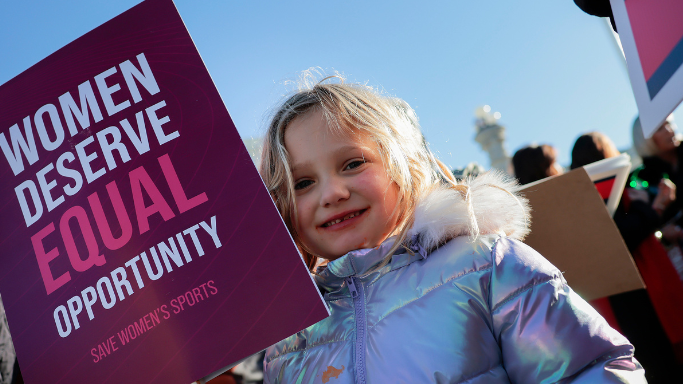
WASHINGTON D.C. — In one of the most consequential victories for women and girls since the enactment of Title IX, the United States Supreme Court today upheld laws protecting women’s sports in West Virginia v. B.P.J and Little v. Hecox, affirming that states may preserve female athletic competition based on biological sex. This is a major victory for sex-based rights.
The historic decisions mark the first time in American history that the nation’s highest Court has ruled on state laws protecting women’s sports. In a sweeping 9-0 decision, the Court held that West Virginia did not violate Title IX. In a 6-3 decision, the Court held that both West Virginia and Idaho did not violate the Constitution’s Equal Protection Clause.
The majority opinion makes clear that “sex” and “gender identity” are distinct concepts and cannot be treated as the same thing. Justice Kavanaugh wrote:
“The term ‘sex’ in Title IX cannot plausibly be interpreted to refer to anything other than biological sex.”
Kavanaugh’s opinion reflects reasoning that has long been central to Independent Women’s report, “Competition: Title IX, Male Athletes, and the Threat to Women’s Sports,” which is grounded in years of legal and policy research documenting the biological realities that make sex-separated athletics necessary. He wrote:
“Sports are highly competitive and generally zero sum. At almost every turn, someone wins and someone loses.”
It is also notable that Justice Kavanaugh’s majority opinion includes precise, sex-based language consistent with the definitions Independent Women has long advanced through model legislation defining terms such as “woman,” “man,” “male,” and “female,” reforms now enacted in 18 states and reflected in federal policy. Rather than using gender identity terminology, the Court wrote:
“We are acutely aware of the difficulties sometimes faced by boys who identify as girls (and by girls who identify as boys) in middle school, high school, and beyond…. But in conducting the equal protection inquiry, we must also account for the effects on girls who are forced to compete against biological males in sports.”
By recognizing the legitimacy of sex-based athletic categories, the Court reinforced the very foundation of Title IX—ensuring that women and girls retain equal opportunities to compete, earn scholarships, break records, and succeed on a level playing field.
Independent Women, which has spent a decade building a national movement to stand with women through legal advocacy, model legislation, policy research, storytelling, grassroots organizing, and litigation support, applauded the rulings as a watershed moment in the fight to preserve women’s rights under the law.
Through Independent Women’s Law Center, the organization filed amicus briefs in both West Virginia v. B.P.J and Little v. Hecox, documenting the real-world harms experienced by female athletes forced to compete against males and presenting scientific evidence demonstrating the male physical advantages in athletic competition. The briefs drew heavily from Independent Women’s third edition of “Competition: Title IX, Male Athletes, and the Threat To Women’s Sports.”
May Mailman, director of Independent Women’s Law Center, said: “Today’s victory is for the girls who have been injured, excluded, degraded, and belittled for standing up for their own sports. There’s much work to be done. This ruling merely says women’s sports are legal, but it doesn’t preserve their right to them.”
Beth Parlato, senior legal counsel for Independent Women’s Law Center, said: “Today is a landmark victory for women and girls across America. The Supreme Court correctly held that neither Title IX nor the Constitution requires states to erase the biological distinctions that make women’s sports possible. The Court recognized what the law has always required: equal athletic opportunity depends on separate women’s sports based on biological sex. This decision restores the law to its original purpose and confirms that states may protect female athletes and preserve women’s sports for women.”
While today’s ruling is a landmark victory, lasting protections require further legislative action. Congress should codify sex-based protections into federal law, and the remaining states should enact laws protecting women’s sports and sex-separated spaces. Independent Women will continue leading that effort until every woman and girl is protected, regardless of where she lives.
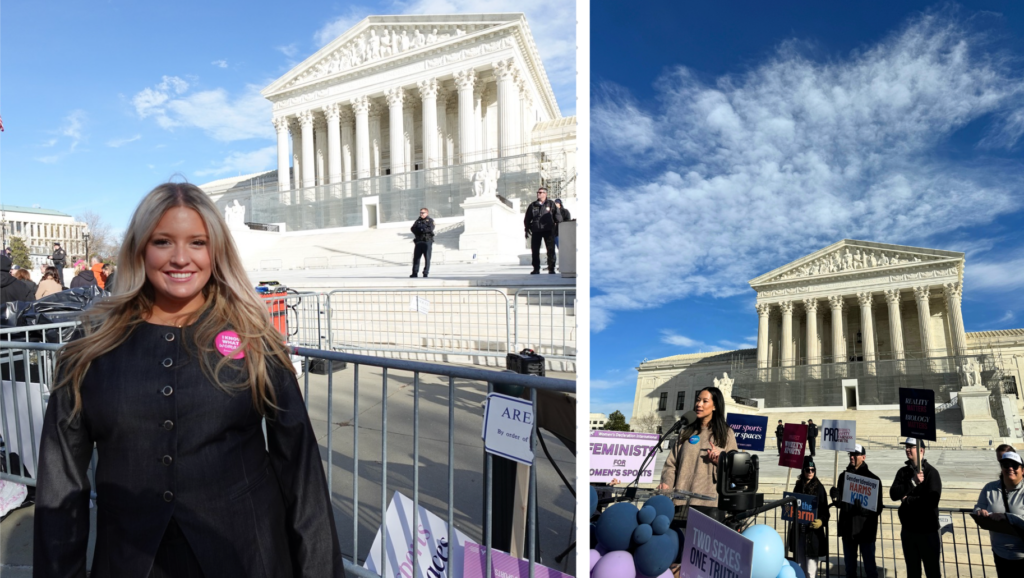
LEFT: Payton McNabb outside the Supreme Court. RIGHT: Independent Women’s Law Center Director May Mailman speaking outside the Supreme Court in January 2026.
The Athletes Who Changed the Conversation
The Court’s decisions reflect years of testimony from female athletes whose opportunities, safety, and privacy were compromised when males were permitted to compete in women’s sports.
Since 2017, Independent Women, through its grassroots storytelling and investigative journalism arm, Independent Women’s Features (IW Features), has elevated these voices—giving a national platform to athletes who lost championships, scholarships, roster spots, records, privacy, and, in some cases, suffered serious injuries while competing against male athletes.
Independent Women Ambassadors React
Payton McNabb, former high school athlete injured by a male athlete on the opposing team, said:
“Today is a full circle moment. I’m deeply grateful and overwhelmed with joy that truth and fairness were affirmed. This ruling recognizes what so many of us have been saying all along: that protecting women’s and girls’ sports is not exclusion, it’s justice. Biology isn’t bigotry, and today that truth was finally given weight!”
Linnea Saltz, former cross country athlete who was forced to compete against the first male DI athlete identifying as female, said:
“I am encouraged to see that the highest court in our country recognizes the fundamental unfairness of allowing men to compete in women’s sports. This ruling is an important step toward protecting fairness, preserving opportunities for female athletes, and restoring common sense in women’s athletics.”
Madisan DeBos, former DI track athlete who was forced to compete against a male athlete, said:
“This is a massive win for women’s sports! So many courageous girls and women have stood up to this fight, and today we all got a victory. As a coach to many young women, I couldn’t be happier to have taken a big step in the right direction for their dreams and safety in sport!”
Read Madisan’s Independent Women Features op-ed celebrating today’s ruling: Finally: SCOTUS Sides With Women’s Sports
Kaillie Humphries, Olympic gold medalist who has become an advocate for sex-based rights, said:
“Women’s sports have given me opportunities that changed my life. I know I’m only here because of the generations of women who fought to create and protect those opportunities. The female category was established so biological women could compete on a level playing field, and preserving that fairness is essential. Today is a win not only for me and my fellow advocates, but for the generations of girls that will step onto a field, court, track, or rink after me.”
Amie Ichikawa, a former inmate who has become an advocate for women-only spaces, said:
“Today’s rulings are a powerful reminder that rights built to protect women and girls cannot be redefined out of existence. Fairness is not hate. Boundaries are not discrimination. Biological reality matters, especially in spaces where safety, privacy, and equal opportunity are on the line. This decision is a victory not only for the brave young women I’ve grown to respect and love, that have firmly stood their ground, but for every girl who has the right to compete, succeed, and thrive on a level playing field. Truth prevailed today—and that matters for the future of this nation, and for our right to win and exist as women. Today, we are no longer a subcategory of ourselves!”
These women helped put a human face on what was too often dismissed as a theoretical debate.
Leading Up to The Court’s Ruling
Long before the women’s sports issue dominated headlines, Independent Women became the original architect of model legislation, Stand With Women Legislative Options, to preserve the legal existence of women as distinct from men by defining sex-based terms—including “woman” and “man”—in law. Today, 18 states have enacted versions of Independent Women’s model.
In the months leading up this Supreme Court ruling, Independent Women’s ambassadors and experts shared the stakes of such a decision, highlighting the importance of preserving women’s sports and maintaining sex-based protections for female athletes in law:
- I Am A Woman Who Had To Compete Against A Man And It’s Anything But Fair Play | Linnea Saltz
- A Supreme Court Test For Women’s Sports | Payton McNabb
- Breaking barriers should not mean breaking women’s sports | Linnea Saltz
- Women’s sports, sex, and the Supreme Court | Beth Parlato
- The Supreme Court Must Find the Courage to Defend the Truth on Women’s Sports | Payton McNabb
- Detransitioners know the truth—men don’t belong in women’s spaces | Prisha Mosley
- Reality on Trial – The Supreme Court, Women’s Sports, and What Comes Next for New Hampshire | Bronwyn Sims
- What Happens When The Laws Women Fought For Stop Protecting Them? | Payton McNabb
- Dignity for Thee—Not for Me | Amie Ichikawa
For media inquiries or booking requests, please email [email protected].
###
Independent Women’s trusted experts, analysis, and data enable us to drive informed conversations to build support for better policy solutions.
Independent Women’s Law Center provides unique legal perspectives around key issues and supports wronged individuals to bring justice and to drive game-changing policies.

Independent Women®’s unique methods and trusted brand shape public preferences, policies, and movements to create a better future for everyone.