


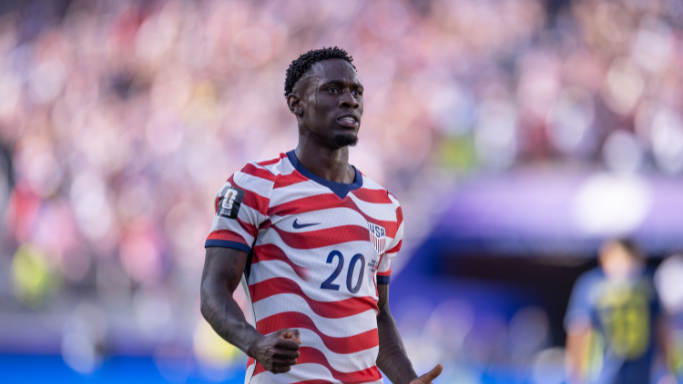
Thankfully, FIFA nullified the suspension of United States soccer player Folarin Balogun, who received a red card during World Cup play against Bosnia and Herzegovina last week. He was kicked out of that game and, under the rule, would be suspended for today’s match with Belgium.
Most people believe the call was a serious injustice, and President Donald Trump jumped in to point out to FIFA President Gianni Infantino that a review of the consequential call was in order. It is not illicit for him to do so, nor is it inappropriate. He is fighting for America’s team, which seems like a natural reaction.
Another impressive reaction was that of Balogun himself. On the field, he took the flagrant call with dignity and grace. There was no screaming at the referee, no sitting on the field kvetching about how he’d been wronged, no pouting or throwing up his hands as we often see with American athletes in other sports. He stood dazed, like all the fans watching, then walked off quietly to the locker room, not making a spectacle of what was obviously an injustice.
This seems to be the way FIFA games operate. Even opponent players came over to console him.
Balogun is an American thanks to birthright citizenship, a debate that has been going on for years and was decided last week by the U.S. Supreme Court. His Nigerian-born parents were visiting the United States in 2001, and because his mother was so close to giving birth was not able to return to their home in London before he was born.
He was raised in London and could have played for England or Nigeria. Balogun chose to play for the United States.
According to FIFA’s eligibility rules, players can represent any country for which they hold citizenship or to which they can demonstrate a “clear connection” through parents, grandparents or five years of residency.
Despite the connection, what is striking about FIFA games (among many things) is watching the players sing all-out for their country’s national anthem at the beginning of the game. Often, players throw with their arms around each other or stand in a salute posture, beaming with pride for their country as they sing.
American athletes in professional sports often refuse to sing the national anthem or are simply too cool to do so. There was a time when some even took a knee instead or turned their back while the Star-Spangled Banner was being played in some kind of protest of the country in which they have excelled and are substantially paid.
No doubt many of the players on these teams have issues with their own countries. Take Argentina for instance. Superstar Lionel Messi plays for a country that was colonized by Spain and has been noted for racism for years. Like the U.S, Argentina and every country in the World Cup has a history of mistakes. Yet, these guys look so proud to represent this flawed country.
During the Olympics with our great hockey team and other athletic achievements, and now with the World Cup, Americans get so excited about our teams and have national pride. The camaraderie and mutual respect for all teams pours when entire stadiums are singing John Denver’s classic song “Country Roads” at the end of every game.
The World Cup has enlightened many to the beauty and uniqueness of America. Let’s hope in this 250th birthday year, this view of America spreads to our own teams and that these great athletes realize that they live in a great country and will sing out the national anthem proudly.