


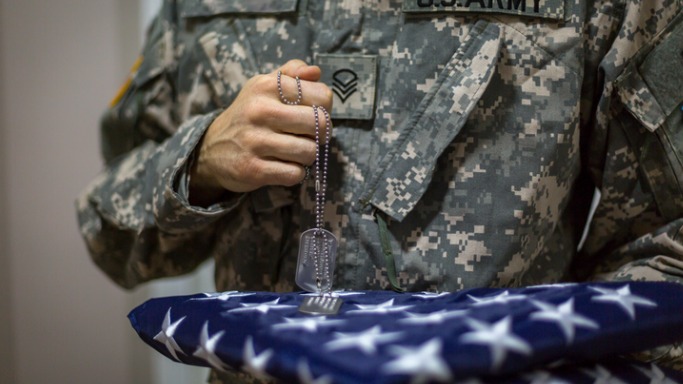
One month after President Trump announced the commencement of Operation Epic Fury on February 28, 2026, to dismantle the Iranian regime’s security apparatus, the Pentagon formally added Epic Fury to the Defense Casualty Analysis System (DCAS). Maintained by the Pentagon’s Defense Manpower Data Center, DCAS serves as the authoritative repository of verified casualty data—meaning it tracks U.S. military personnel who are killed, wounded, missing, or otherwise injured in wars and named operations. By formally adding Epic Fury to DCAS, the Pentagon is not only providing a centralized, publicly accessible record of casualties in real time. It is also providing families, analysts, and lawmakers with transparency about and the ability to monitor the human cost of U.S. military operations.
Operation Epic Fury has thus far claimed the lives of 13 American men and women in uniform. Ten are men; three are women. Seven of these lives lost are due to direct enemy action, and therefore classified as “hostile” deaths, while six are classified as “non-hostile.” All seven hostile deaths occurred in the U.S. Army. The Air Force experienced the six non-hostile deaths when a U.S. Air Force KC-135 refueling aircraft crashed in Iraq while on a combat mission in support of Epic Fury on March 12.
Notably, the majority of the deceased were serving in the Reserves at the time of their death, rather than being Active Duty (meaning, in very basic terms, the former were more “part-time” than “full-time” military). The Reserve component of the U.S. Armed Forces, made up of the National Guard and the reserves, is known as the nation’s second line of defense. Ever since the 9/11 attacks, the reserve components of the military, but especially of the army, have shifted from more of a “strategic force” to an operational one. Where before 9/11, deployments of reservists were rare and few, if any, carried a combat patch, nearly the opposite is true today: More than 300,000 Army Reserve soldiers alone have been mobilized and deployed around the globe since 2001. This is one of the unseen but real human costs of fighting wars for 25 years while, for electoral politics reasons, refusing to raise the levels of active duty forces commensurate with such military activities. The six Reserve and three National Guard servicemembers killed during Epic Fury are just the most recent reminder of this hard truth.
While government websites like DCAS and watchdog organizations and independent analysts like Militaryspend.org and Globalmilitary.net, and Brown University’s Costs of War project can keep track of the raw numbers of money spent, equipment expended, casualties incurred, and lives lost, the very real human beings who were precious members of a family, a workplace, and a community each deserve a quiet moment of reflection on their gift of their life that they this year gave our nation. This May, let us remember U.S. Army and Air Force, Reserve, National Guard, Active Duty, officer and enlisted alike, all those names officially released or privately held:
Sgt. Declan Coady, 20, of West Des Moines, Iowa (Army Reserve)
Capt. Cody Khork, 35, of Winter Haven, Florida (Army Reserve)
Sgt. 1st Class Nicole Amor, 39, of White Bear Lake, Minnesota
Sgt. 1st Class Noah Tietjens, 42, of Bellevue, Nebraska (Army Reserve)
Maj. Jeffrey O’Brien, 45, of Indianola, Iowa (Army Reserve)
Chief Warrant Officer 3 Robert Marzan, 54, of Sacramento, California (Army Reserve)
TSGT Ashley Brooke Pruitt, 34, of Bardstown, Kentucky (Air Force)
MSGT Tyler Hanani Simmons, 28, of Columbus, Ohio (Air Force National Guard)
SSG Benjamin Pennington, 26, of Glendale, Kentucky (Army)
Maj. John Alexander Klinner, 33, of Auburn, Alabama (Air Force)