

It may be close to impossible to sever United States trade ties with China.
The two superpowers, although adversaries, may be joined at the hip for many years to come. Second-term Republican President Donald Trump of America and President Xi Jinping of the People’s Republic of China didn’t let go of their trade truce after the first state visit by a Chinese leader to the U.S. in 11 years. This comes as a disappointment to many, especially congressional members who have called for less trade and stricter measures with China.
“The CCP is the single greatest threat to America’s national security and financial independence,” explained Sen. Pete Ricketts, R-Neb., arguing the need to prevent a CCP-led world.
China’s foreign minister has called for the U.S. and China to “remove interference and overcome obstacles” between Trump and Xi. Yet, interference and obstacles are exactly what the Chinese Communist Party and its global network are directing at the United States. Their playbook almost entirely consists of influence campaigns to topple America internally – especially aimed at energy and environmental progress.
For years, foreign influence campaigns have arisen as a major concern across a variety of American industries, aimed at stifling growth in oil and gas, critical minerals, data centers and plastics. These industries are essential to everyday tasks and quality of life. Stifling these industries means stifling American economic growth and harming U.S. energy security.
California is increasingly becoming a China-first state. Eileen Wang – Chinese spy and former mayor of Arcadia, Calif. – is definitely China-first, and former House member Eric Swalwell was caught sleeping with a Chinese spy. California isn’t sleepwalking into embracing China, it is running towards a China cliff.
The radical tycoon Neville Singham is synonymous with Chinese influence operations, as the Beijing-based businessman has reportedly spent over $250 million on pro-CCP activities in the United States. However, a lesser known name, Andrew Forrest, is weaponizing lawfare against Americans and their natural resources. By doing so, he is harming American economic prosperity, seemingly to the benefit of China.
Forrest is funding the California plastics suit brought by Sierra Club, Surfrider Foundation, Heal the Bay, and San Francisco Baykeeper that targets ExxonMobil’s plastic production. The funding of the lawsuit is being filtered through the Intergenerational Environment Justice Fund, a Minderoo-affiliated nonprofit founded by Forrest, to California-based law firm Cotchett, Pitre & McCarthy. That law firm is now behind major litigation that seeks to impede ExxonMobil’s operations to the detriment of hundreds of millions of Americans.
Not coincidentally, Forrest is the founder and executive chairman of Fortescue, a mining and energy company that receives nearly 90% of its revenue from buyers in China.
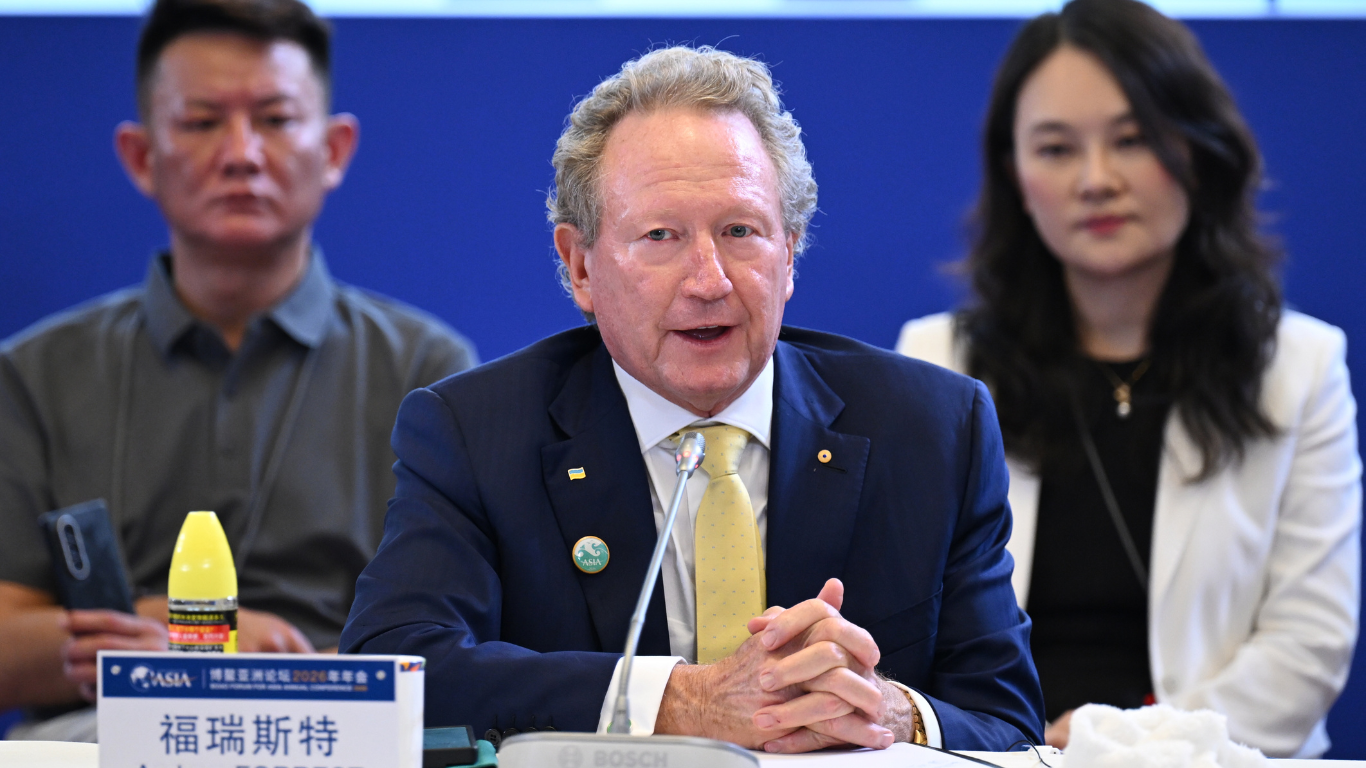
“Bilateral trade has supported Australian jobs, businesses, and public services, and also provided China with a secure and reliable supply of iron ore that drove its extraordinary, unprecedented, historic, and industrial growth,” Forrest, who is also Fortescue’s executive chair, told the Boao Forum Perth, an offshoot of the larger Boao Forum for Asia which pushes for anti-U.S. energy dominance policies and falsely recognizes China as model for green development.
ExxonMobil claims, not unreasonably, that Forrest’s lawsuit aims to cripple a pillar of the American hydrocarbon industry. The corporation said in legal filings, “Fortescue appears to have adopted a novel strategy for competing against American oil-and-gas producers,” meaning sue them rather than try to outperform them in the free market. And ExxonMobil pointed out that Forrest’s weaponization of American courts shows “the corrupting influence of foreign money in the American legal system.”
That corrupting influence is manifestly problematic for American consumers. China is also looking to grow its market share of plastic demand, another reason to sponsor an influence campaign targeting the American plastic industry. With production shifting to China and away from the United States, supply chain vulnerabilities go up, and American industrial leaders like ExxonMobil also lose valuable capital that could be used to sponsor innovation here at home.
Why is Forrest, an Australian mining executive, orchestrating a major influence campaign in the United States against a leading American oil-and-gas company? Possibly because he is pressured by Chinese officials who seek to undermine U.S. industry. That is dangerous if true – and a foreign assault on our democracy and prosperity.