
America was not born perfect. She was born with a promise. And the story of this country has been the long, unfinished work of making that promise real.
There were no founding mothers on that parchment. But women were never absent from the American story. They endured it, defended it, sacrificed for it, strengthened it, and, when history demanded it, helped save it.
As America celebrates her 250th birthday this year, a generation of young women needs to be reminded that they are not strangers to this inheritance. They are not guests in the American experiment. They are its rightful heirs.
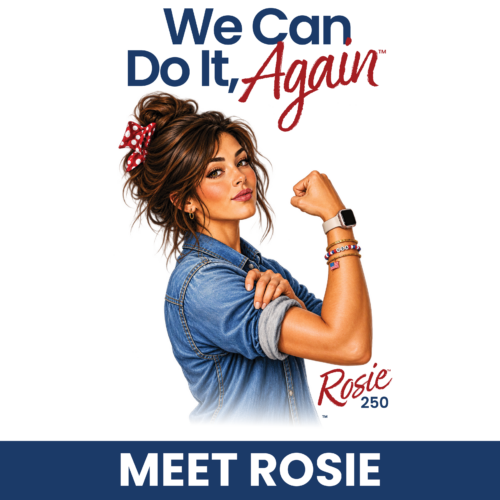
Thankfully, that reminder already has a name.
She wore a red bandanna. She had her sleeves rolled up. She built the arsenal that helped defeat tyranny in the most catastrophic war the world has ever known.
She was Rosie the Riveter.
Rosie was never the rejection of family or motherhood.
There is no better proof of what American women can do when the country calls on them than what they did between 1941 and 1945. When the men went to fight, more than six million women answered without hesitation, entering factories, shipyards, and defense plants. The female share of the American workforce surged from 27% to nearly 37% in five years. By 1945, nearly one in four married women worked outside the home. In the aircraft industry alone, women went from 1% of the workforce before the war to 65% by 1943, more than 310,000 women building the planes that carried freedom across every ocean. Three million more volunteered with the Red Cross. Over 200,000 served in the military itself.
The War Advertising Council’s Women in War Jobs campaign, built around the Rosie the Riveter image, became the most successful advertising recruitment campaign in American history. It succeeded because it did not argue about womanhood. It did not impose an identity or demand that women choose between their femininity and their patriotism. It simply told the truth: your country needs you, and you are equal to the task.
This call extended to more than just white women.
African American women answered it too, even when they were not pictured on the posters. After civil rights leaders, including Mary McLeod Bethune, pressed the Roosevelt administration, President Franklin D. Roosevelt signed Executive Order 8802, banning discrimination in defense-industry hiring and helping open wartime work to black Americans.
Roughly 600,000 black women entered the wartime workforce, moving into factories, shipyards, offices, and defense industries that helped power America’s victory. Many came from domestic work, farm labor, and other low-wage jobs. Wartime work offered something different: better pay, new skills, and a chance to prove what had always been true.
Their path was harder. Discrimination did not disappear because the country was at war. But black Rosies helped build the arsenal of democracy anyway, and in doing so, they claimed a larger place in the American story.
That is the promise of Rosie: not perfection, but progress.
And American women proved they were up to the challenge. Over the past seven decades, women’s labor force participation rose by 75%, climbing from one out of three women in the workforce in 1948 to an all-time high of nearly two out of three in 1999. Nearly half (48%) of the U.S. workforce is female, and women today are more likely to hold multiple jobs than men. Since the 1970s, women have outpaced men in college completion, acquiring greater proportions of degree holders for associate’s (62.8%), bachelor’s (58.5%), master’s (62.6%), and doctoral (57%) degrees. Consequently, young women routinely outearn men, and non-mothers maintain wage parity with their male counterparts over their careers (even as pay gaps widen with motherhood). Now, for the first time, over half of American families feature a full-time working mother and father.

Rosie was never the rejection of family or motherhood. She was proof of something more radical than any ideology that has come since — that American women were capable of everything. She could build a B-17 bomber and raise a child. She could weld steel and hold a family together. She could answer a national call and still be fully, undeniably herself. Rosie did not diminish femininity. She revealed its full dimensions.
Both frameworks on offer today fail because they impose identity rather than liberate it.
Too often today, the conversation surrounding women has collapsed into a false binary. You are told the ideal woman is either the perfectly curated “trad wife” devoted entirely to the home or the hyper-independent career woman who measures worth only through professional achievement. In reality, most women live somewhere between and beyond both. Most women want love and ambition. Family and purpose. Stability and freedom. They want the dignity of choice.
Both frameworks on offer today fail because they impose identity rather than liberate it. They have traded the audacity of Rosie, a woman who could do anything, for the smallness of a cultural argument about which kind of woman is morally superior.
The truth is that there is no singular blueprint for a good woman. There never was. That is the American idea.
A good mother may stay home with her children. Another may run a company while raising them. A good wife may choose a quiet family-centered life. Another may deploy overseas, teach in classrooms, build businesses, practice medicine, or serve in government. Some women may choose not to marry at all. Some may sacrifice careers for family. Others may pursue both imperfectly and courageously at the same time. The beauty of the American promise was never conformity. It was freedom: radical, capacious, unapologetic freedom.
Rosie matters because she embodied that freedom at its most urgent. She showed the world that strength and femininity are not opposites. Patriotism and ambition are not opposites. Family and public contribution are not opposites. American women should not have to choose between dignity at home and dignity in the world. Rosie never did. And when the men came home from war, the point was not that her work ended. It was that her freedom remained. She had earned the right to choose what came next, and that choice meant everything.
Reclaiming Rosie is not an exercise in nostalgia. It is an answer to a crisis already showing up in the lives, choices, and confidence of American women.
Young women are experiencing a crisis of belonging, not because America has failed them, but because the cultural conversation has failed to tell them the truth about what America is.
Gallup’s numbers reveal something deeper than dissatisfaction. Young women are losing confidence in the institutions that hold the country together. In 2015, their confidence score was 57. By 2025, it had fallen to 40. Over that same decade, men over 45 moved in the opposite direction, rising from 49 to 64. This is not a generic crisis of trust. It is a generational and gendered rupture in American confidence.
A 2025 poll found that 40% of young American women say they want to leave the United States permanently, a figure that far exceeds the 20 to 30% in comparable advanced economies who say the same. Gen Z women report some of the highest rates of mental health distress ever recorded, with 40% experiencing prolonged periods of sadness or hopelessness. One in three young adults between 18 and 25 reports feeling lonely, and 44% say they feel like they matter to others only “a little” or “not at all.”
This is a generation that has been systematically told, by the media, by academia, and by warring ideologues, that the country beneath their feet is not worth believing in. That the air they breathe is poisoned by history. That patriotism is naïveté and sacrifice is exploitation. Those are lies, and young women are paying the price for believing them.
Across much of the world, this kind of freedom — the freedom young American women have been taught to resent — does not exist. The 2024 SDG Gender Index found that 91 out of 139 countries were rated “poor” or “very poor” in protecting women’s personal autonomy, individual rights, and freedom from discrimination. Only 57% of countries globally had any domestic violence legislation as of 2024; among authoritarian regimes, that number fell to just 54%. A 2025 UN Women report found that nearly a quarter of governments worldwide reported a backlash on women’s rights in 2024. In those countries, women do not get to debate which cultural framework honors their identity. They fight for the right to leave the house unaccompanied, attend school, choose whom to marry, and keep what they earn.
The American woman who is told to despise her country is standing in the freest place women have ever stood in the history of the world. At Independent Women, we intend to say that plainly, unapologetically, and over and over again.
The American woman who is told to despise her country is standing in the freest place women have ever stood in the history of the world.
The modern Rosie should not tell women what role to choose. She should remind them that they are free to choose at all, and that the freedom to choose is not a small thing. It is one of the rarest things in human history. It was purchased at enormous cost by the generations of American women who came before, and it will be defended or squandered by the generation coming now.
Rosie should reconnect women to the audacity of the American idea itself — the belief that your life is yours to build, that your contribution matters, and that your country is strong enough to hold every different version of a well-lived life at once. Not some lives. All of them.
The nurse working double shifts. The military officer deployed overseas. The mother raising children with integrity and sacrifice. The entrepreneur building a company from nothing. The teacher forming the next generation. The welder. The police officer. The stay-at-home mom. The scientist. The farmer. The caregiver. The journalist. The woman holding together a struggling family while working two jobs.
All of them Rosies. All of them American.
America is the greatest country on earth not because it is flawless, but because its founding idea — that human beings are endowed with the capacity for freedom and the right to exercise it — has proven to be the most powerful organizing principle in the history of civilization. Every generation has had to reclaim it, defend it, and pass it on. The women of World War II understood that. They did not debate whether America deserved their labor. They picked up the rivet gun.
At America’s 250th anniversary, we should tell women something true, and something powerful: the inheritance is still yours.
This country — imperfect, dynamic, endlessly renewing itself — belongs to every woman willing to show up for it. It belongs to the woman in the boardroom and the woman in the delivery room. To the woman in uniform and the woman in the classroom. To the woman who chose a quiet life and the woman who chose the arena.
Rosie the Riveter was never about forcing women into factories. She was about opening doors that had once been closed and trusting women to walk through them.
Two and a half centuries in, those doors are still open.
The next generation of American women deserves to know they are not standing outside the American story, asking permission to enter it. They are already inside it. They are heirs to its promise, stewards of its future, and builders of whatever comes next.