

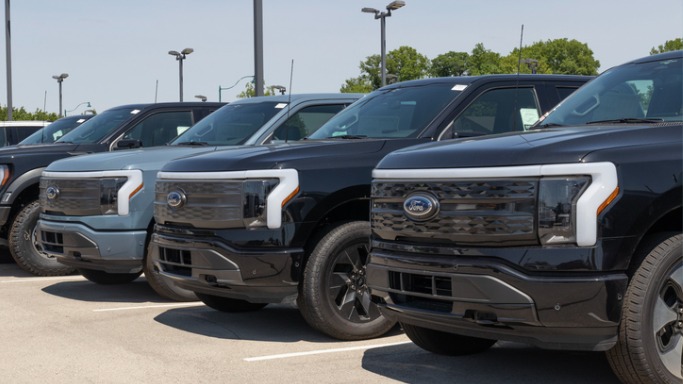
The Wall Street Journal reported this month about internal deliberations at Ford Motor Company to scrap the F-150 Lightning, the company’s money-losing electric vehicle (EV). The Journal reports that Ford has suffered $13 billion in EV losses since 2023, which is expected to worsen with an “absence of government support.”
The One Big Beautiful Bill Act (OBBBA) repealed the Clean Vehicle Tax Credit, which provided consumers with $7,500 for purchasing a new EV. Buyers of used EVs used to qualify for $4,000 tax credits and $40,000 for commercial EVs, respectively.
The tax credits expired September 30, 2025, with a temporary 30% increase year-over-year in EV sales as consumers moved to lock in tax credits. Sales are expected in the final months of 2025 to drop to about 5% of total U.S. auto deliveries. In October, Ford’s overall U.S. EV sales fell 24% from the prior year.
A 2023 study by the Texas Public Policy Foundation suggested that EVs would cost almost $50,000 more to own over ten years than internal combustion vehicles if not for subsidies, regulations, and other hidden costs.
EVs are out of reach for many consumers without tax credits. According to Spectrum News, the average transaction price for an EV is $57,245—compared with $48,179 for an average internal combustion vehicle. Basic models of the F-150 Lightning have gone to $50,000 and higher-end models approach $90,000.
The Wall Street Journal adds:
‘The demand is just not there’ for F-150 Lightning and other full-size trucks, said Adam Kraushaar, owner of Lester Glenn Auto Group in New Jersey. He sells Ford, GMC, Chevy and other brands. ‘We don’t order a lot of them because we don’t sell them.’
Ford paused production of the F-150 Lightning last month due to aluminum shortages.
It’s not just Ford’s problem. General Motors and Stellantis are also pivoting from EVs, with both companies awaiting news of $500-million grants from the Department of Energy to build EV plants. Stellantis canceled the plug-in hybrid electric version of its Jeep Gladiator pickup truck in September 2025, as well as canceled an electric full-size pickup, citing low demand. And Shell has agreed to sell a “substantial portion” of its EV charging network, Volta, which it has owned for less than three years.
As it turns out, mandating and subsidizing a product that few consumers can afford and want to purchase is enormously expensive for companies and taxpayers.