

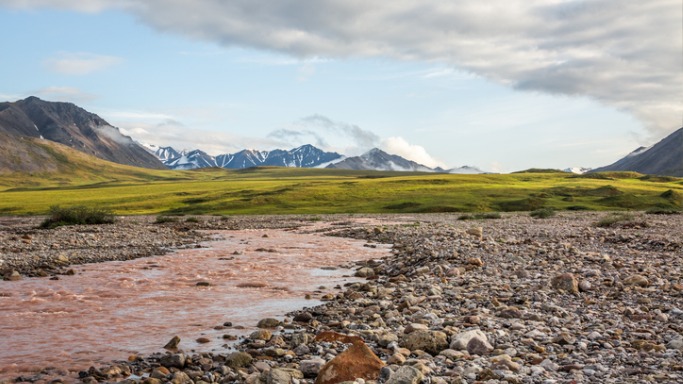
On October 6th, President Trump approved the Ambler Road access project in northwest Alaska. The decision approves the appeal made by the Alaska Industrial Development and Export Authority (AIDEA), the public-private corporation sponsoring the project.
The Ambler Road is a proposed 211-mile private road that will unlock access for exploration and development of significant quantities of zinc, lead, silver, cobalt, and copper. Of the route trailing east from Alaska’s Dalton Highway, about 24 miles is on federal lands in the Gates of the Arctic National Park and Preserve. This stretch of federal land triggers permitting by the Bureau of Land Management, the National Park Service, and the U.S. Army Corps of Engineers.
The permitting history of the not-yet-built road is long. Access to the mining district is promised under the 1980 Alaska National Interest Lands Conservation Act, which clearly states that “the [Interior] Secretary shall permit such access” to the district. Earnest planning began in 2015, and in July 2020, the Trump administration approved the road with a 50-year right-of-way. In June 2022, the Biden administration voluntarily suspended the permits and redid its environmental statements before shutting down the road entirely in 2024. In June 2025, AIDEA appealed the decision.
The Interior Department’s rationale in 2024 was laughable: Since ANILCA only explicitly mentions the Parks Service, it claimed that the Bureau of Land Management (BLM) doesn’t have to issue permits. This argument was the subject of the appeal judged by the White House. President Trump’s full 27-page statement of reasons can be found here.
Political squabbles over natural resources hurt Alaskans waiting on the promise of good-paying jobs. The fact sheet claims that the construction of the road will directly support 2,730 jobs and provide $1.1 billion in revenue to the state of Alaska from mining license tax revenues, corporate income taxes, production royalties, and claim rents. The White House’s fact sheet notes that there are more than 1,700 active mining claims in the Ambler mining district, which have thus far only been accessible by air or winter ice roads.
While projects seldom see unanimous support, many tribal leaders have recognized the economic benefits of the road. The late Wilmer Beetus, chief and mayor of Hughes, Alaska, said in 2023 that the project “is an opportunity to create high-paying jobs within the region so that our tribal members and their families can remain in their communities.”
Opposing domestic mining projects also hurts those who want critical minerals for electric vehicles, wind turbines, and solar panels. These minerals have to come from somewhere, and that is most often from overseas mines controlled by China that do not adequately protect the environment or worker health and safety. The Ambler Road’s environmental plans build in “extensive mitigation measures, including caribou protection policies and fish passage culverts,” and any mines built in the area would be subject to the U.S.’ strong environmental protections.
The Ambler Road is a test of whether the United States is serious about securing its own supply of the critical minerals that power modern life. The law is clear, the economic promise is real, and the environmental safeguards are in place. Alaskans shouldn’t be held hostage to years of bureaucratic delay and political posturing. The Ambler Road can prove that responsible natural resource development and environmental stewardship go hand in hand.